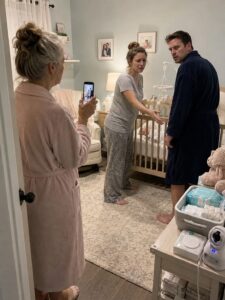
The Quiet Woman in the Doorway
The crying started at three in the morning, the way it always did, a thin and insistent wail cutting through the silence of a house that was never quite mine. I had learned the rhythm of that house over the two months I’d been staying in the guest room, the creak of the third stair, the way sound traveled strangely through the hallway, and so I was already moving before I fully registered I was awake, my bare feet finding the cool hardwood without needing light to guide them.
What I didn’t expect, when I reached the nursery door, was what I saw inside.
My daughter Mia was on her knees beside the rocking chair, both arms reaching toward the crib where her son Noah lay crying beneath a mobile that turned in slow, useless circles above him. Her husband, Caleb, stood between her and the crib, not touching her, not needing to. His stillness was the threat. He didn’t have to raise a hand when his voice alone could pin someone in place.
“Let him cry,” he said, and there was nothing frantic in his tone, nothing a stranger walking past the window might have flagged as wrong. That was the thing about men like Caleb. They didn’t shout. They didn’t need to. “Maybe you’ll think twice before ruining my dinner again.”
Mia’s voice came out small and pleading. “Caleb, please. He’s hungry.”
“He can wait.”
I stood in the doorway without making a sound, my thumb already finding the camera icon on my phone before my mind had caught up to my hands. Some instinct older than thought told me this moment needed to exist somewhere other than memory, because memory could be doubted, reshaped, talked out of itself by someone skilled enough at rewriting reality. I had watched Caleb’s father do exactly that for years at charity dinners and fundraising galas, the particular art of men who never raise their voice because they’ve never needed to. Control wrapped in good manners. Confidence as a weapon.
It took him three seconds to notice me.
The change in him was immediate and total, like watching someone slip on a different face. The coldness vanished, replaced by the easy, polished warmth that made everyone at his parents’ parties adore him.
“Eleanor,” he said, stepping back from the crib as though he’d simply been standing nearby, concerned. “This isn’t what it looks like.”
I walked past him and lifted Noah from the crib myself, feeling his small body tremble against my chest as his cries softened into hiccups.
“It looks exactly like what I’m seeing.”
Caleb gave a short laugh, the kind designed to suggest I was the one being unreasonable. “You don’t understand marriage, Eleanor. Mia’s exhausted. New mothers get emotional.”
Mia said nothing. She kept her eyes on the floor, and that silence told me more than any explanation could have. My daughter, who used to argue with referees at her own soccer games when she was eight years old, who once stood up in a packed lecture hall to correct a visiting professor, had learned to make herself small in her own home.
Caleb’s eyes moved to the phone still in my hand. “Delete that.”
“No.”
His smile thinned at the edges. “Be careful, Eleanor. You’re living in my guest room.”
I kept rocking Noah gently, feeling his breathing even out. “Your guest room?”
“My house. My rules.”
“Mom, don’t,” Mia whispered, and that whisper hurt worse than anything Caleb had said. My bright, fearless daughter was trying to protect me instead of herself, which meant she had already absorbed, somewhere deep and quiet, the lesson that protecting herself never worked.
Caleb took a step closer, his voice dropping into something almost gentle, almost reasonable, the tone of a man explaining something to someone who simply couldn’t grasp it. “You’re a retired widow living on a teacher’s pension, Eleanor. Don’t start something you can’t finish.”
I looked at him then, really looked, taking in the silk robe, the easy confidence, the absolute certainty that nothing in his life would ever truly be challenged. I thought about how long I had let people underestimate me, and how useful that had always been. Quiet women learn the most. Forgotten women notice everything.
I kissed Noah’s forehead, felt his small fist curl against my collarbone, and smiled at my son in law in a way that I knew would unsettle him more than any argument could.
“Caleb,” I said, my voice perfectly calm, “you have absolutely no idea what I can afford.”
By morning he had decided fear would solve everything, the way it always had for him.
I came downstairs to find him sitting at the marble kitchen island sipping coffee while Mia stood at the stove with a split lip she’d tried, not entirely successfully, to hide beneath foundation. His parents, Richard and Vanessa Voss, arrived before eight, summoned with the efficiency of lawyers called in for damage control.
Vanessa air kissed Mia’s cheek without quite making contact. “Darling, motherhood doesn’t excuse chaos.”
Richard looked at me the way you might look at a stain you hadn’t noticed until it was too late to avoid stepping near it. “Caleb tells us you had an episode last night.”
“Did he,” I said.
Caleb leaned back in his chair, utterly at ease. “Mom, she filmed a private family moment. She’s unstable.”
Mia flinched but said nothing.
Vanessa sighed, the practiced sigh of someone delivering bad news with great reluctance. “Eleanor, we all understand grief can make women intrusive. But Caleb has been more than generous letting you stay here.”
This was the story they wanted everyone to believe. Poor widowed mother in law, fragile, dependent, prone to dramatic misunderstandings. Easy to dismiss, easier still to pity.
Richard slid a manila folder across the counter toward me. Inside was a nondisclosure agreement and a check for fifty thousand dollars, a threat wearing the costume of generosity.
Caleb’s grin returned in full. “Take it. Go back to your little condo.”
“My condo sold two years ago.”
He blinked, genuinely caught off guard for the first time since I’d met him. “What?”
I closed the folder without signing it. “You didn’t know that?”
Richard’s expression sharpened, and I understood in that moment that this was true. They had never bothered to learn anything real about me, because men like Caleb and his father only study the people they consider dangerous, and a sixty something widow living quietly in their guest room had never registered as a threat worth understanding.
Two years earlier, after my husband Daniel died, I had sold the condo, liquidated most of our remaining investments, and joined the board of a private family foundation we had spent the last decade of his life quietly building together. Caleb had always assumed my late husband was simply a retired school principal, a sweet, unremarkable man who’d spent his life grading papers and chaperoning dances. What he never bothered to learn was that before education, Daniel Mercer had founded a compliance software company used by law offices across half the state. When he died, I had inherited far more than memories and a modest pension.
I had inherited leverage, and the patience of forty years spent teaching frightened children how to use their voices.
I didn’t reveal any of that yet, though. Revenge taken too early is only anger wearing a different coat. Revenge done properly requires evidence, timing, and witnesses who can’t later be paid into forgetting what they saw.
So I lowered my eyes and let them mistake my patience for surrender. “I’ll pack,” I said quietly.
Mia looked stricken. Caleb looked triumphant, the particular triumph of a man who believes he has just won something permanent.
That afternoon, while Caleb played golf with investors and his parents congratulated themselves over lunch, I made three phone calls from the guest room.
The first was to my attorney, Lila Grant, a sharp, unflappable woman who had once described her own courtroom style as polite until it isn’t. The second was to a domestic violence advocate whose organization I had quietly funded for years through the foundation, never attaching my name publicly to the donations. The third was to Detective Alvarez, a man whose wife ran a shelter that had received a new security wing the previous spring thanks to a grant Daniel’s foundation had approved before he passed.
Then I backed up the video from the nursery to three separate encrypted accounts, because I had learned, in my years of supporting women trying to leave situations exactly like this one, that evidence which exists in only one place can disappear with frightening ease.
By evening, Caleb had grown careless with his confidence. I found out later, watching the footage afterward with hands that wouldn’t quite stop shaking, that he had cornered Mia in the hallway near Noah’s room, unaware that the small white noise machine I had given them for the baby’s first birthday contained a camera that had been quietly streaming to my phone the entire time.
“You think your mommy can save you?” His voice carried a hiss that hadn’t been in his tone at breakfast. “You leave, you get nothing. No house. No money. No baby. My father knows judges, Mia. Real ones, the kind that matter.”
Her voice came back so small I had to turn up the volume to hear it. “I just want Noah safe.”
Caleb laughed, that same easy, charming laugh he used at dinner parties. “Then obey.”
In the guest room, I watched every second of it twice, then a third time, my jaw tight, my hands steady in a way that surprised me even as it happened. And for the first time since I had moved into that house, I smiled, not from happiness, but from something colder and more certain. They had not, as they clearly believed, cornered a fragile old widow with nowhere else to go. They had cornered a mother who had spent four decades teaching frightened children how to find their voices, and two decades quietly funding the lawyers who made men exactly like Caleb regret every silence they had ever counted on.
The next morning I asked them all to gather in the living room, and to their credit, or perhaps simply their arrogance, every single one of them came without suspicion.
Caleb arrived freshly shaved, dressed in a navy suit, as though cruelty required proper tailoring. Richard stood near the fireplace with his hands clasped behind his back, every inch the patriarch surveying a minor inconvenience. Vanessa sat on the sofa, diamonds catching the morning light at her throat. Mia sat beside me, pale and quiet, Noah asleep against her chest in the sling she’d started using again that week.
Sometimes, late at night, I still find myself standing in doorways the way I did that first night in the nursery, checking on them both without quite meaning to, an old habit from decades of mothering that I suspect will never fully leave me. And every time, I find exactly what I hope to find. My daughter sleeping peacefully. My grandson safe in his crib, his small chest rising and falling in the dark.
No one standing over either of them, demanding silence in exchange for love.
That, in the end, is the only justice that ever really mattered to me. Not the headlines, not the collapsed development deal, not even the satisfying click of handcuffs closing around a man who had mistaken cruelty for power. Just this quiet house by the water, where my daughter gets to raise her son free of fear, and where the only sounds at three in the morning, if they come at all, are answered with comfort instead of cruelty.
Power, I’ve learned, was never the same thing as strength. Fear was never the same thing as respect. And the quiet woman standing in the doorway, the one everyone in that house had so confidently dismissed, turned out to be the only person paying close enough attention to end it.